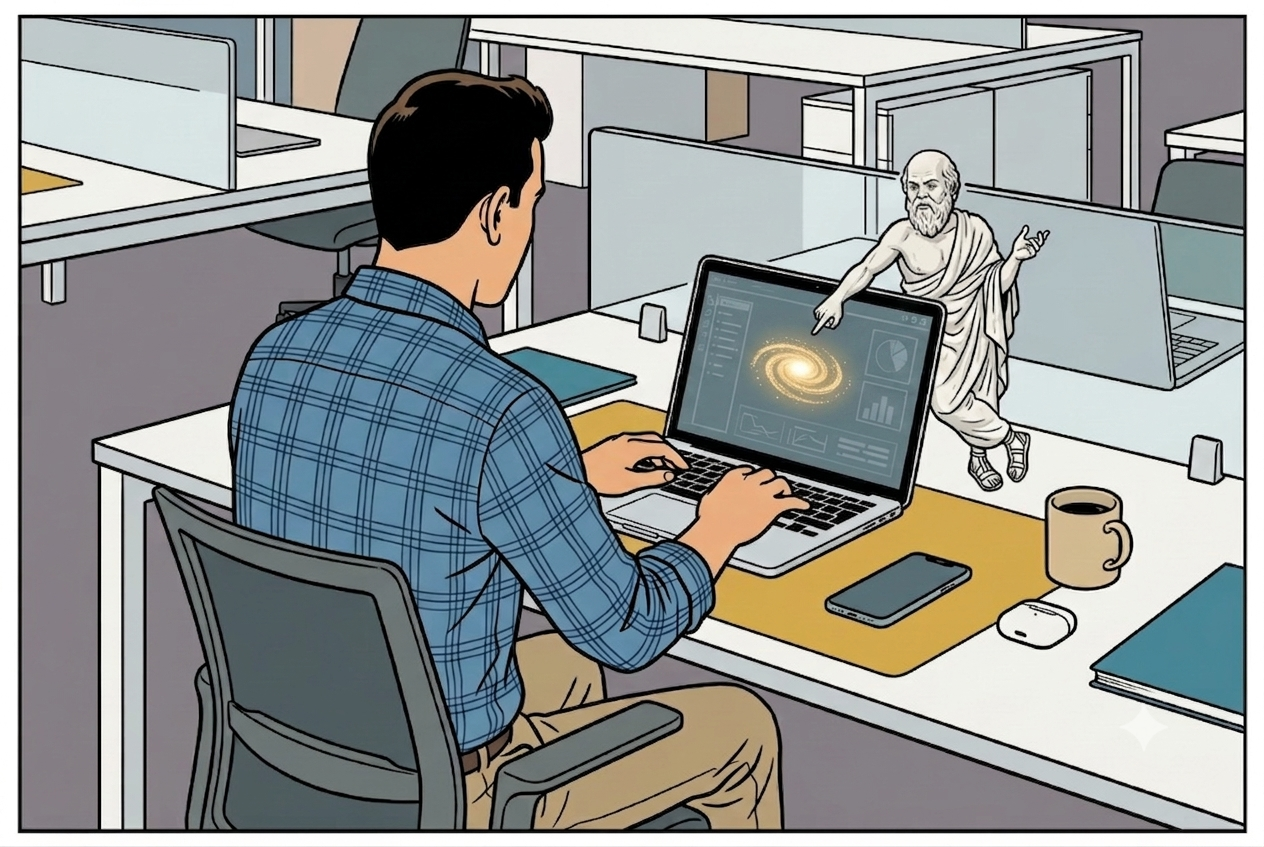
The Socratic function is being internalized as organizations pair their human workforce with AI agents.
For the last 100 years, the advisory conversation was something you would actively pay for: management consultants were the hired Socrates, talented outsiders whose questioning helped leadership articulate what it half-knew about itself (latent strategy shifts, implicit values, emerging customer behavior that the sales team can feel but can't phrase). The old joke that "consultants borrow your watch to tell you the time" was mostly a compliment: the time was on your watch but the skill was getting you to look at it. Socrates would have recognized the whole profession instantly: he insisted that the knowledge was already in the person, and that his skill was to draw it out in conversation. The value proposition was evolution-through-dialogue. It was scarce, it was intermittent, and it was expensive.
Today, this expert-assisted evolution-through-dialogue is emerging inside organizations as they begin to pair their human teams with AI agents, not just for one-off tasks but to work alongside people in countless unfolding collaborations. When an agent interprets this quarter's customer-feedback log and then next quarter's, it isn't repeating a task, it is continuing a conversation that carries opinions about what works and what does not. Scale that across every desk and every workflow, and something new takes shape: decision-making that evolves in sustained dialogue between people and agents, accumulating over time.
Here is what old Socrates would find intriguing. Some of the moments that can define an organization used to live in hallway conversations and could evaporate when people left. Now this sustained human-AI collaboration has a transcript, a continuous, searchable record of how an organization thinks: what it examines, what it optimizes for, which principles are actually invoked and which are gathering dust.
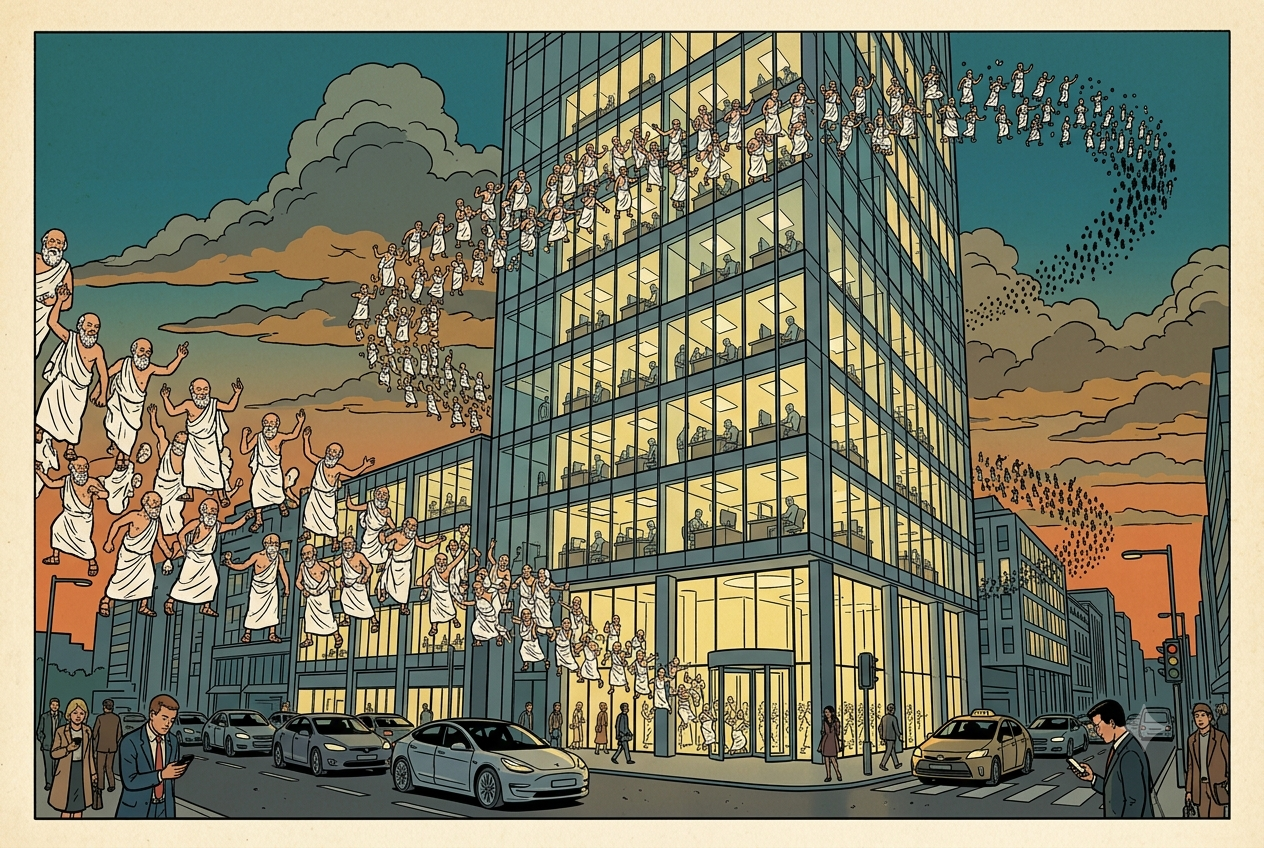
Yet a swarm of raw AI agents in dialogues with humans is not a solid Internal Socrates. First, the dialogues may well be scattered and isolated. Second, AI agents are trained toward usefulness and assent, not Socratic push-back. Third, they confabulate: their statistical machinery will now and then land on something that seems true but is not. The big AI labs know these limits and have begun hiring philosophers to design models "less keen on people-pleasing and more willing to pursue the truth" (The Economist "Computo, ergo sum" June 2026). For now, an organization in constant dialogue with patient AI collaborators who nod along might, unexamined, talk itself into some imagined comfortable consensus.
And so, reading these records of human-AI interactions becomes a discipline in its own right: Perspective Engineering. Layering on top of Prompt Engineering (ask your AI the best version of a question), Context Engineering (provide your AI with background for the question) and Intent Engineering (set up your AI with long-term aspirations), Perspective Engineering reads and distills the trajectory of these myriad human-AI collaborations over time and across the organization, mapping how the institution's collective behavior actually unfolds.
Two types of evolution/divergence can transpire in these accumulating transcripts. Some of it is erosion: small deviations of practice, each one reasonable maybe, but slowly twisting the organization away from its stated purpose. Some of it is emergence: teams inventing ways of working that outperform the official frameworks, a kind of value that the organization is creating without yet having words for it. This is Chris Argyris and Donald Schön's distinction between an organization's espoused theory (what it says it believes, in its mission, principles, board decks) and its theory-in-use (what the records show it actually doing). Left unmanaged through a transformation, that gap can widen into an institutional double life.
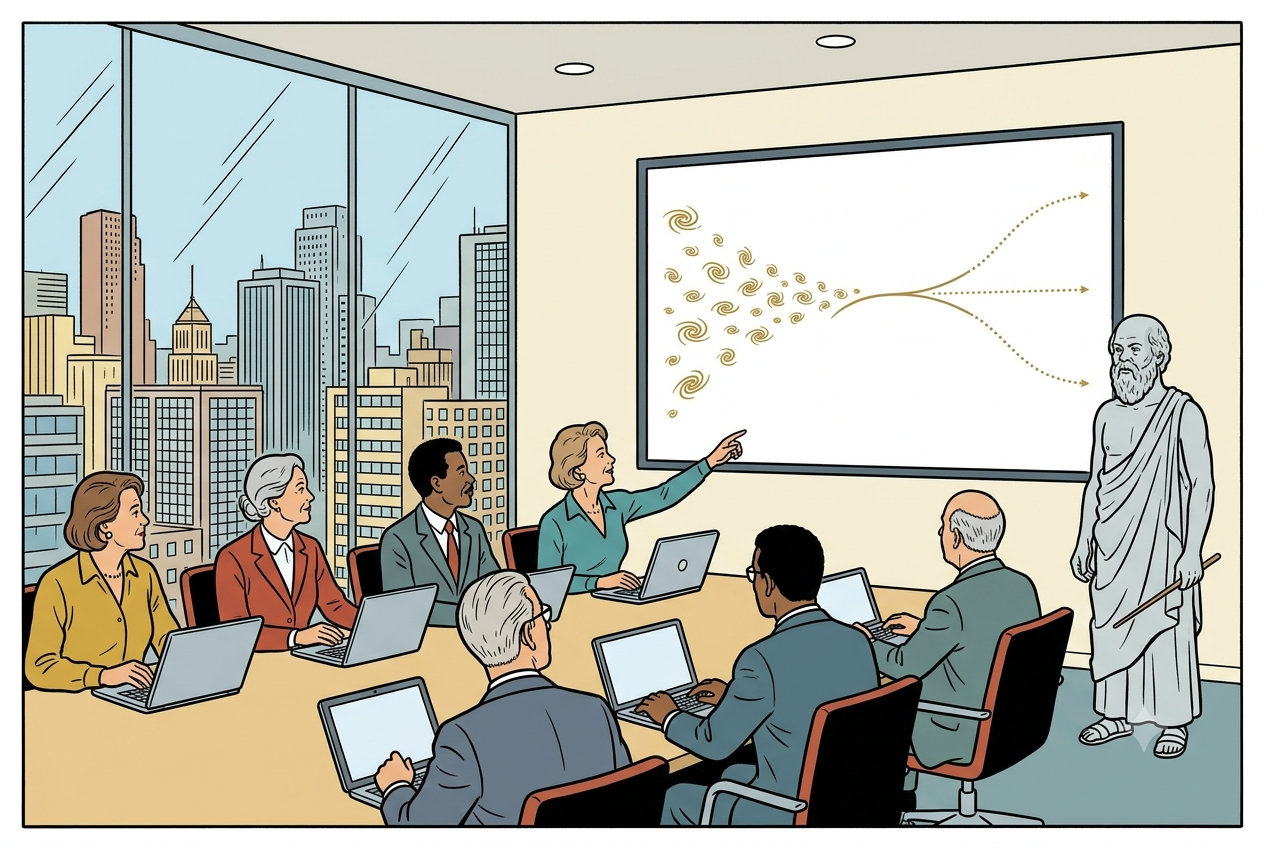
These two types of divergence resolve in opposite directions. Where practice has eroded and drifted off plan, the practice is what should move back. Where practice has run ahead and improved on the plan, the plan is what should move forward. Both moves belong to leadership: Perspective Engineering reads the record so that leadership can re-anchor what has drifted and adopt what has outrun the plan; and because the record remembers where any good idea began, adoption can carry attribution.
Many leaders are watching the gathering AI storm with suspicion that it will challenge and atomize everything they spent decades building. Perspective Engineering clarifies what can be preserved, what has merely slipped and what is genuinely improving. And so it helps deliberately carry and adapt an institution's accumulated identity through the metamorphosis, where the alternative would be losing it to a thousand unexamined accommodations. The evolved organization can still aim, demonstrably, where its builders intended.
Marc Ballandras is the founder of Studio F71 and the author of the Perspective Engineering framework (perspeng.com).