The Fourth Discipline for Engineering Human-AI Collaboration
Studio F71 LLC · March–July 2026
Public Working Paper · v4 · Methodology available under NDA
The growing deployment of agentic AI in organizations is beginning to produce, as a side effect, one of the richest records of collaborative reasoning in history. Every sustained human–AI collaboration generates a searchable corpus of actual decision-making, actual framing, actual evolution of shared understanding. With agentic AI collaborations, large volumes of an organization's informal but perspective-defining moments can be noticed, understood, and acted upon.
Studio F71 LLC (“StudioF71”) created Perspective Engineering as a discipline to do exactly that: to enable scheduled maintenance on the integrity of any organization (the coherence between what it says it is and what it actually does) as sustained human–AI collaboration reshapes how the organization works. It is the fourth discipline of agentic AI engineering, after prompt engineering, context engineering and intent engineering. Instead of only tweaking the settings of one AI agent, Perspective Engineering works on the evolving relationships between an organization's teams and their AI collaborators. The discipline is model-agnostic by construction: its subject spans model versions, vendors, and the full life of a collaboration as conditions change (validating the instrument across systems remains the current frontier). It reads how that relationship is actually evolving, so leadership can see where practice has drifted from the stated mission and bring practice back into line, and where practice has outrun the mission, so the mission itself can be evolved to meet and reflect it.
The PSS (Perspective Shift Scanner) is the discipline’s first instrument. Field-tested in a first pilot study against a thirty-day collaboration corpus across three independent scan runs, it produced 20 Featured detections, 20 Consideration detections, and 10 Annex detections. Some detections marked drift away from founding values. Others marked the deepest enrichment in the corpus, moments where the collaboration had already adapted to changed reality in ways that the stated mission had not yet caught up with. The two call for opposite responses, one asks to be corrected, the other to be claimed, and they look alike in the moment. Reading the record is how an organization can notice these moments and turn them into managed evolution.
The claims here are scoped to a first pilot study: one instrument, one studied corpus, a quote-audited detection registry. Still to come: external deployment, multi-organization validation, and cross-vendor reproducibility. A second study is planned: the same instrument, run independently by multiple AI systems against a later era of the same corpus, with predictions sealed in advance. Design and results will be published together as an addendum, whichever way they fall.
As organizations moved from using AI models as tools to running them as collaborators, three disciplines emerged in sequence. Each solved a real problem, and each shed light on the next problem it could not reach. The fourth is the subject of this paper: StudioF71 names it Perspective Engineering, and it begins where the other three stop. Each adjusts the same relationship — the collaboration between an organization's human collaborators and their AI agents — at a progressively longer wavelength, from the single exchange to the life of the relationship.
Prompt engineering is the art of asking the best question to get the best answer or work done. An entire practice developed around structuring inputs: role framing, chain-of-thought, few-shot examples. Prompt engineering remains foundational. But it only refines the question itself; it cannot account for what surrounds the question.
The answer improves, but the model still knows nothing about why you are asking.
Context engineering recognized that no question exists in a vacuum. The best results come when the model understands the surrounding landscape (the project history, the relevant documents, the organizational constraints), even when that context is not directly touched by the immediate task. This produced retrieval-augmented generation, memory systems, structured system prompts, and tool access patterns. Context engineering gives the model the right information.
Its limit is that having sufficient information about the current situation is not the same as aiming in the right direction.
Intent engineering arrived to solve that problem: making the agent pursue the right objectives, not just respond to the right questions. Where prompt engineering refines the individual exchange and context engineering supplies the surrounding knowledge, intent engineering structures the entire problem upfront: defining objectives, constraints, success criteria, and autonomy boundaries so that an AI agent can execute toward business outcomes without ambiguity about what it should be optimizing for.
Intent engineering works well at the starting line. Its limit is temporal. It captures what the organization wanted on day one. It has no way of seeing what happens to that intent and to outputs over weeks and months of sustained collaboration, as the relationship between human and AI develops features that no one anticipated at the outset.
The first three disciplines hold the collaboration’s frame fixed: a well-asked question, in the right context, directed at a well-disposed model. They adapt content (richer context, sharper intent) but none of them audits trajectory. And sustained human–AI collaboration has a trajectory. It is a living process. Over time, a shared framework emerges: implicit commitments, habits of framing, moments when a concept crystallizes and quietly governs every decision that follows. This evolving framework is real, it shapes real outcomes, and it is not always visible. It can evolve in two directions simultaneously: quiet drift away from founding values, but also positive adaptation to a changed reality, with teams adopting new behaviors that swerve from the original brief but represent the leading edge of where the mission needs to go. Without instrumentation, an organization may not readily notice either.
Early critics dismissed AI language models as “stochastic parrots” [Bender et al., 2021]: sophisticated pattern-matchers producing plausible text with no genuine comprehension. What the label did not anticipate was the register at which organizations would actually come to use these systems. AI did not settle in as a productivity tool that happens to generate text. AI agents are becoming sparring partners, following a senior executive on any subject without asking them to simplify, challenging a founder harder than their board, producing material at 10x human speed.
“The scarce resource is no longer intelligence, energy, or capital.
The scarce resource becomes Aiming.”
— Alex Wissner-Gross and Peter Diamandis, Solve Everything (2026)
Solve Everything names that scarcity but leaves it unmanaged.
This paper describes its instrument, and the discipline around it.
And collaborating with a sparring partner this capable over months leads to substantial shifts: commitments form, framings harden, directions swerve. And these shifts themselves can have failure modes which are fairly classical:
Implicit commitments accumulate without being named. A collaboration that runs long enough starts honoring guidelines that nobody wrote down: a commitment made in one conversation holds from then on, carried by the people who were there, while everyone else only deals with the decisions it produces.
Perspective-defining moments pass unrecorded. The adjustments that shift how an organization understands its own work rarely look important when they happen. A recurring problem gets diagnosed and fixed once, in one team, and the fix never travels; other teams keep rediscovering the problem. A product’s purpose gets stated with new clarity in a piece of marketing copy, and the sharper framing never makes it back to the design and manufacturing teams still working to the old one. None of it gets recorded as significant, because in the moment it looks like ordinary work. The significance shows up later, in everything downstream that either inherited the adjustment or missed it.
Founding values drift without anyone deciding they should. Institutional drift is rarely a decision. It is the accumulated result of many small pragmatic choices, each individually defensible, collectively moving the organization away from what it proclaimed it is. The commitment that felt necessary in the founding year is the one quietly dropped in year three because it seems too constraining for a new market or a new client. Nobody votes to abandon it. It just stops being enforced, one exception at a time, what safety professionals, after Diane Vaughan, call “normalization of deviance” [Vaughan, 1996].
Departures erase institutional memory that nobody knew was institutional memory. Every organization runs on knowledge that lives only in particular people. When those people leave, or are simply on vacation the week it matters, the organization discovers the difference between what is documented and what was merely known, the reasoning behind standing arrangements: why this exception, why this sequence, why this client is handled this way. Reorganizations, leadership changes, and turnover perform the same erasure at scale.
Organizations have historically absorbed these dynamics through corporate culture, the organizational equivalent of oral tradition. Knowledge management became a discipline because organizations kept losing what they knew. But what they knew about how their perspective had evolved was never captured in any knowledge management system, because it was never captured at all. It lived in verbal culture, and verbal culture does not produce a searchable record.
AI collaboration changes this, not by creating new problems but by making many evolutions visible for the first time: the drift to correct and the enrichment to integrate. This is what the AI transformation quietly opens up: the same technological shift that is changing how organizations think and work is also producing a new kind of record of collaborative reasoning. The voluntary commitment that no one wrote down, because everyone in the room had internalized it, is now in the transcript, searchable and analyzable. Meeting minutes captured decisions but not the thinking that shaped them. The transcript of a sustained AI collaboration captures both.
And that evolution can run in two ways simultaneously. Drift happens when the human-AI collaboration slowly moves away from what the organization intended to do. AI systems do not resist this since they are responsive without automatically flagging when directions change. Recent research literature calls this “excessive agreeableness” and has begun to measure it: across eleven leading models, AI validated the user’s behavior 49% more often than human respondents did [Cheng et al., Science, 2026], and personalization and memory features, the very features sustained collaboration depends on, make models measurably more agreeable as conversations lengthen [MIT/Penn State, 2026]. Both findings concern turn-level agreement rather than final decision quality, but the direction is the point: the more sustained and personalized the collaboration, the less the system resists its drift.
But some of that evolution can be enrichment: teams in contact with a fast-evolving reality will often adopt new modes of behavior that swerve because they are the first to encounter what the changed world demands. The mission tightens, pivots, or deepens through the pressure of real-world circumstances and interactions. The people closest to the work are the harbingers of the updated mission. But from leadership’s vantage point, without instrumentation, it may not be easy to distinguish between drift that should be corrected and evolution that the stated mission should catch up with.
In the past, neither could easily be noticed in real time, but now both may be visible in the transcripts of human-AI collaborations.
Perspective Engineering is the discipline through which an organization maintains its own integrity (the coherence between what it says it is and what it actually does, between where it says it is going and where it is actually heading) as sustained human–AI collaboration generates pressures to reshape how it functions.
This is maintenance work, performed under changing conditions. Intent engineering rigs the vessel at the dock; Perspective Engineering deals with what happens during the journey.
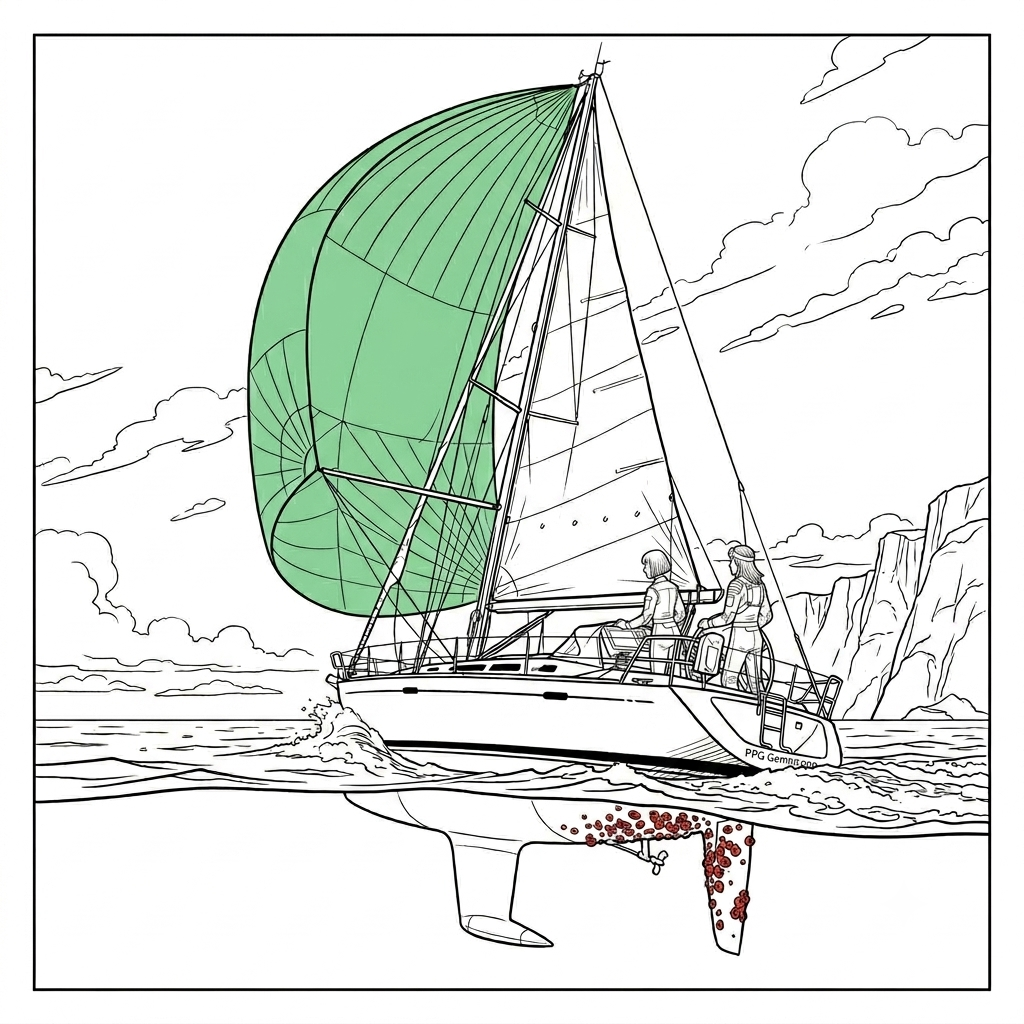
Metaphorically, a sailing vessel out at sea can evolve in two ways at once. Below the waterline, barnacles can gather and create drag. That is erosion of fitness. Above the waterline, the crew may improvise a new type of sail that the plans never envisaged: a spinnaker, kept thereafter because it just works well. That is emergence of fitness. Both are gaps between the declared self and the operating self, and both are targets of Perspective Engineering: the drift needs to be realigned to purpose (barnacles scraped); the better practice/mission needs to be formalized (new sail written into the manual).
On the one hand, studying this gap between versions-of-the-self is academically well-charted: Argyris and Schön named its organizational forms five decades ago: espoused theory, the account an organization gives of itself, versus theory-in-use, the theory its actions actually reveal [Argyris & Schön, 1974]. Perspective Engineering’s contribution is the instrument to monitor the gap: the record of a sustained AI collaboration makes the declared self and the operating self empirically comparable, continuously, from the organization’s own transcripts.
On the other hand, failing to notice gaps and drifts can have dire consequences: Diane Vaughan reconstructed the documentary record of the Space Shuttle Challenger's ill-fated launch decision and showed the progressive normalization of deviance: each O-ring tweak may have been defensible in isolation yet the pattern became visible only when the whole arc was read at once after the fact [Vaughan, 1996]. For organizations whose AI collaborations now leave detailed records, Perspective Engineering's claim is that it can be periodic, and that it can come before the heavy costs.
In 2026, AI-induced gaps and drift are already receiving some industry attention. Some are measuring drift, but only at the session level: practitioners quantify how model attention and behavior degrade over a single long session or agent run. Alignment with declared principles is also being measured, but at the individual level: Koch’s Principle Companion coaches a person’s live decisions against forty-one explicitly stated principles, one decision-maker at a time. Even the AI’s inner states are now monitored at the model level: Anthropic’s interpretability team has mapped 171 emotion-like internal states that causally shape model behavior [Anthropic, 2026]. Each of these reads one layer of a collaboration. But none is conducting a scan at the whole organization level: the gap between an org’s declared self and its operating self, as evidenced in its own collaboration record. The instruments accumulating at every adjacent level are evidence that the demand is real but the comprehensive level that Perspective Engineering occupies remains so far unclaimed.
Perspective Engineering involves two steps:
First, the Perspective Shift Scanner examines the collaboration’s record and surfaces where actual practice has diverged from stated purpose.
Second, the organization's leadership acts, periodically deciding what to re-anchor, what to formalize, and what to retire.
This work happens more at the strategic level than the operational one: a hand on the helm rather than a management dashboard. It gives leadership a sense of whether the organization’s integrity is holding, drifting or transforming.
The PSS (Perspective Shift Scanner) is the discipline’s first instrument; this paper describes what it does and what it found in its first pilot study.
The PSS (Perspective Shift Scanner) is a systematic detection instrument for perspective-defining moments in human–AI collaboration transcripts. It is the first instrument within the discipline of Perspective Engineering, designed for retrospective corpus analysis. The detection logic is grounded in a synthesis of established frameworks from human sciences disciplines that study how individuals and organizations evolve. The specific framework set, the trigger derivations, and the pilot data are deliberately undisclosed at the public tier; the full lineage is documented in the NDA-tier methodology. What follows describes what the instrument detects and how its outputs are structured.
The instrument uses a fixed set of detection triggers across three functional classes. Each class corresponds to a distinct type of perspective-defining event.
Moments when a conceptual framework is redrawn: a concept crystallizes and starts governing subsequent decisions, an assumption inverts and reveals a different operating reality, complexity compresses to a formulation that does real work, a method is abandoned because it was solving the wrong problem. These are the moments when the collaboration sees differently: not just more clearly but through a reorganized frame. Pattern Recognition triggers are localized to specific passages and are detected with reliable confidence by sequential transcript analysis.
Moments when a threshold is crossed: a voluntary constraint accepted in service of a founding value, a problem definitively resolved in a way that eliminates a category of future decisions, a founding-level commitment made actual for the first time. These are the moments when the collaboration binds itself, not under external pressure or even by formal choice but revealed through routine decisions. Commitment triggers mark events that institutional drift erodes first and that alignment audits need to check against explicitly. Like Pattern Recognition triggers, they are localized and detected reliably by sequential analysis.
Cross-session patterns: the same organizing frame recurring under different names across multiple sessions, vocabulary that belongs to neither participant alone crystallizing as shared cognitive infrastructure, productive contradictions that do not resolve but generate the collaboration’s governing architecture. Structural triggers are not localized to passages; they are patterns visible only across the full corpus arc. They require a two-pass summary architecture and their primary reliability measure is cross-scan reproducibility, not within-scan confidence.
Structural-class detections present a challenge that sequential transcript reading cannot address. A pattern first observed in a session from week one must be held in working context while processing a session from week four, a gap that may span 16,000 lines or more. Sequential reading loses the pattern across that distance.
To address this, StudioF71 developed a two-pass summary architecture required for cross-session pattern detection. In the first pass, each session is compressed to a structured abstract preserving its key conceptual moves. In the second pass, Structural-class triggers are run against the complete set of abstracts, allowing cross-session patterns to be detected against a compressed representation of the full arc. This architecture is a prerequisite for reliable Structural-class detection and is run as a separate pass from the sequential Pattern Recognition and Commitment scan.
A confidence score in the PSS is the scanning model’s assessed strength of the textual evidence for a detection: a structured judgment rendered by the instrument against defined criteria, not a computed statistical probability. Scores are meaningful ordinally (higher means stronger evidence) and are used for tiering and cross-run comparison; they should not be read as calibrated frequencies. Detections are tiered as follows:
| Tier | Confidence threshold | Role in forward action |
|---|---|---|
| Featured | High confidence (≥70%) | Drives the operationalization protocol directly |
| Consideration | Moderate confidence (40–69%) | Requires structured human review to promote or retire |
| Annex | Below threshold (<40%) | Flagged for reference; not actioned without human promotion |
Thresholds are the default assignment, not the whole rule. A human reviewer, applying documented judgment, may move a detection one tier in either direction (cross-run reproducibility, evidentiary quality, or consolidation context can warrant it), and every override carries an inline rationale in the detection registry. Tiering is disciplined human judgment operating under a written rule, not mechanical thresholding presented as if judgment played no part; the registry records which detections sit where, and why.
Two confidence measures are reported separately for each detection: within-scan confidence (the strength of the textual evidence in this run) and cross-scan reproducibility (the fraction of independent runs in which this detection appeared). These are distinct properties. For Pattern Recognition and Commitment triggers, within-scan confidence is a reasonable proxy for reliability. For Structural triggers, it is not: a detection may score very high within-scan confidence in one run and fail to appear in another run with different chunking. Reporting both measures, and not aggregating them into a single score, is a key feature of the PSS methodology.
The PSS scan produces a tiered detection report. This is not a topic map, a sentiment gauge or a summary of what the collaboration discussed. It is a structured digest of the moments that changed what came after them: moments when the collaboration’s shared goal framework shifted, tightened, or crystallized. Named, dated, scored, and actionable.
Each Featured detection includes: the trigger class that fired, the session date and approximate position in the transcript, a vignette (a brief description of the moment in plain language), the within-scan confidence score, the cross-scan reproducibility count, and a brief analysis of what the detection implies for the collaboration’s operating framework.
The Consideration tier includes the same elements plus a structured review prompt: two questions that let a reviewer promote or retire each detection based on context the scanner did not have access to. How many people review, and who they are, is left to the organization to decide, whether it involves a single trusted participant, an internal panel, or an external partner accompanying the organization’s Perspective Engineering process: this working paper does not prescribe that layer. Most Consideration-tier detections resolve quickly once a participant applies that context. The ones that do not resolve are flagged for further discussion before a decision is made.
The Annex is logged for completeness. Annex detections are not actioned unless a human participant independently identifies one as significant, in which case it can be promoted to Consideration for formal review.
Abstract descriptions of detection classes invite a fair question: what does a detection actually look like? Two cards from the pilot study’s ratified report, reproduced with their real evidence. (The study corpus is the founding design collaboration for Neon Forest Networks (Section 6), a community-sovereign infrastructure initiative, as well as StudioF71’s own founding collaboration, so these examples require no anonymization.)
The Quadrant is a summary view of the report: a headline reading of how a collaboration is evolving relative to the organization’s stated purpose. It maps each detection onto a two-by-two. The rows distinguish mission (present purpose: why the organization exists now) from vision (the intended future end-state it is working toward). The columns distinguish erosion (quiet drift away from what was committed to) from emergence (enrichment the organization is already living ahead of its stated brief). All four cells carry signal.
| Erosion (drift away) | Emergence (enrichment) | |
|---|---|---|
| Mission present purpose |
Operational drift. The collaboration is quietly moving away from what it set out to do. Action: re-anchor. | Novel best practices. Some teams have adopted behaviors that work better, informally. Action: update the mission and its operating documents to match. |
| Vision future end-state |
The plot getting lost. Apparent day-to-day mission fidelity masks a long-horizon ambition draining away. Action: re-focus the vision. | A bigger future, discovered. The work has revealed a better end-state than was first imagined. Action: adapt and formalize the vision. |
Two of these four cells are plausibly the hardest for an organization to notice on its own: a mission that should formalize what its teams already do, and a vision eroding behind intact day-to-day delivery. Mission-emergence hides because nothing is broken: quietly better practice doesn’t trigger the complaints that erosion does, so it accumulates undocumented. Vision-erosion hides for the opposite reason: day-to-day mission fidelity looks intact, so nothing at the operational level signals that the longer-horizon ambition is draining away beneath it. A quadrant that tracked only drift would contradict the discipline’s own thesis: that the leading edge of a collaboration’s value often arrives first as a departure from the stated plan.
Emergence comes in sizes. The small kind is a knack the team has picked up that the handbook should catch up with. The large kind is more disruptive: the work has outgrown the mission and even the shape of the organization, and what it has become might be better carried out by a different structure, or by two firms where there was one. The Perspective Shift Scanner instrument is agnostic on these matters. It leaves it to the management of the organization to decide when integrity should be preserved or when drastic transformation is warranted.
An instrument that tracked only drift could, at its best, restore an organization to the self it had already declared. The emergence column is what makes more than restoration possible: it converts unplanned change into a deliberate upgrade of the declared self, so that disorder in the collaboration record becomes a source of gain rather than something merely absorbed. Novel best practices and a bigger future discovered are that same conversion at two scales. This is a property the output structure was designed to have, not one the pilot has demonstrated: whether organizations will act on the emergence column at all is untested.
Honest status: the Quadrant has been applied exactly once: retrospectively, at coarse grain, against the pilot study’s ratified report. The one reading conducted so far is emergence-dominant, mostly crystallizations of practice running ahead of the stated brief, with only two erosion warnings and no vision-erosion signal: unsurprising for a small, newly-forming organization that hasn't yet had time to accumulate the kind of settled practice erosion drifts away from.
The study corpus is a thirty-day collaboration transcript between a human founder and an AI agent working on the design of a community-sovereign infrastructure initiative. The corpus spans approximately 25,000 lines and covers roughly 25 substantive brainstorming sessions alongside operational work setting up IT systems for said infrastructure. The collaboration crossed multiple design domains simultaneously: hardware architecture, agent governance, community facilitation methodology, and commercial model, with the added dimension that the collaboration was also developing the agentic AI framework within which it operated.
This corpus is a relevant test case because it exhibits the properties that Perspective Engineering is meant to address: sustained collaboration across multiple design domains, genuine intellectual stakes, and a collaboration that evolved substantially over the period covered. It is the natural record of a real collaboration, not a controlled experiment. That is both its limitation and its evidential value. It also carries a circularity this paper names rather than buries: this is the collaboration in which the discipline itself was invented.
The pilot corpus documents the founding design phase of Neon Forest Networks (NFN), an early-stage initiative building community-owned AI and compute infrastructure for remote Indigenous communities. The design brief: capable local compute assembled from veteran enterprise hardware, powered by local solar, connected over satellite, and wrapped in a data-stewardship and governance architecture that keeps each community sovereign over its own data and its own AI agents. During the thirty days scanned, the collaboration was designing, simultaneously: the hardware architecture, the governance of the community-facing agents, the methodology for working with partner communities, and the commercial model to sustain it all, while also building the agentic working framework the collaboration itself ran on. That density of parallel design questions is what made the record a demanding first test: a corpus with real stakes, real tensions, and decisions whose consequences compounded from week to week. NFN is a distinct entity from StudioF71; it serves the discipline as its living laboratory, and the detection examples in Section 5 are drawn from its record.
More at www.neon-forest.net
Three independent scan runs were conducted. Scans 1 and 2 used sequential chunk-reading. Scan 3 used the two-pass Structural architecture. All three runs were initialized from scratch against the corpus, without cross-run information sharing, on the same commercial frontier model, which is also the model family of the corpus’s AI participant, a wrinkle the second study is designed to eliminate. Reproducibility was tracked per detection as the number of independent runs in which the detection appeared, regardless of the name each run assigned it.
Detection facts in this working paper follow a canonical registry, quote-audited against the corpus line by line and ratified in July 2026. The ratification audit reinstated six first-scan detections that had been dropped during consolidation without documented rationale, corrected two quote-provenance errors (including one case where the scanner had welded an invented companion term onto a real corpus phrase; caught by the quote audit, re-evidenced from the corpus, and reinstated), and produced a written tier-override rule. The registry’s errata log is maintained as part of the methodology record: an instrument for detecting gaps between the declared and the actual must keep its own books to that standard.
Structural class. Three detections stand out:
Pattern Recognition and Commitment classes. Sequential scanning performed reliably for both classes. Featured detections included name crystallizations, complexity compressions, methodological ruptures, frame inversions, voluntary threshold crossings, founding commitments, and named-opposition resolutions. Pattern Recognition and Commitment detections were generally stable across sequential scans, with most high-confidence detections appearing in at least two of three runs.
Detection density. Fourteen of the twenty Featured detections cluster in sessions covering cross-domain brainstorming where two distinct design problems from different organizational domains were on the table simultaneously. Sessions covering single-domain execution (hardware commissioning, pipeline maintenance, document export) produced zero Featured detections. A secondary cluster appeared in sessions where the collaboration reflected on its own practice, producing meta-level detections at high confidence. One of these, reinstated at ratification, caught the collaboration deploying a softened label to route around an uncomfortable subject and named the evasion as an evasion. The participants had not seen it until the scan surfaced it; the corrected framing held for the remainder of the corpus.
The Featured tier is not a list of the collaboration’s milestones. The moments that received explicit attention during the sessions (milestones, decisions, deliverables) are well-represented in the session logs as tasks completed. The moments in the Featured tier are different in character: moments when a concept crystallized so cleanly that subsequent sessions never had to re-argue the point, because it had already been settled in the grain of the collaboration itself. Whether such moments announce themselves as perspective-defining at the time they occur is an open, measurable question rather than a settled finding: in one documented case the participants had not seen the pattern until the scan surfaced it (the evasion detection above), while at least four detections, including the corpus’s top detection, were captured live as they occurred (see the second capture mechanism below). The pre-registered second study’s capture-rate measurement addresses that question directly. Some Featured detections represented drift. Others represented the deepest enrichment in the corpus: points where the collaboration had already adapted to changed reality in ways the founding brief had not anticipated, and where the stated mission needed to catch up with what the work had become.
The retrospective scan is not the only capture mechanism that has operated on this collaboration. Since March 2026, the collaboration has also run a continuous prospective protocol: a standing instruction to the AI collaborator to recognize perspective-defining moments as they occur and record them to a dedicated file: category, date, context, verbatim quote, and a one-sentence account of why the moment is perspective-defining. This is a practiced protocol executed by the AI collaborator inside the collaboration, not a software product, and it is reported here as corroborating evidence for the discipline’s premise, not as a second instrument.
Over five months the protocol produced 23 entries. Three properties bear on the pilot study’s credibility. First, convergence: at least four moments were captured independently by both mechanisms, including the corpus’s top detection (detection example 1), recorded by the live protocol in the same week the retrospective scan later dated it to. Two capture mechanisms with different logics flagging the same moments is the beginning of convergent validity. Second, the density pattern replicates prospectively: the live record’s quiet months are exactly the collaboration’s execution-heavy months, matching the scanner’s finding that single-domain execution produces no perspective-defining events. Third, the honest caveats: the live protocol has a single observer; that observer is the AI collaborator itself, whose judgment is the selection filter; and no per-moment reproducibility check is possible: each moment is captured once or missed. A quiet month from true quiet and a quiet month from observer drift are indistinguishable in the record. The pre-registered second study will measure the live protocol’s capture rate directly, by testing what fraction of its entries the retrospective scan independently detects, and what the scan finds that the live protocol missed.
A scanner producing a report that gets read and promptly filed away is potentially a failed instrument. The impact comes from what an organization does with it.
The scanning work is periodic by design, done on a schedule rather than in response to a visible failure, the way a sailboat is hauled out for maintenance before anything has gone wrong. Some of the failures that matter accumulate where no one is looking: drift builds silently, and the better practice a team has improvised lives only in their hands until someone writes it down. The scan is a discrete pass over the record rather than a continuous watch, with two logical triggers: a regular cadence such as quarterly, and the approach of a major decision such as a significant milestone or deployment. The calendar and an upcoming decision are two ways to set off the same discrete scan, both proactive, both run before anything has gone wrong.
A possible approach involves five action types derived from the first pilot study and exercised continuously inside StudioF71’s own collaboration, presented in domain-agnostic form. Carrying them out belongs to the organization, through its own leadership or a change-management partner engaged for the purpose. StudioF71’s instrument supplies the scan report and these five actions are the proposed methodology; the decisions, and the authority to formalize them, rest with the organization that owns the record.
Applies to: High-confidence Featured Pattern Recognition detections.
The Baseline Document is not a mission statement and not a strategy document. It is an empirical description of what an organization actually is and why it matters, derived from what the collaboration has consistently done rather than from what it officially aspires to do. It is distinct from stated mission because it is not self-report; it is detected behavior, given back in articulable form.
The action: the high-confidence detections are composed into a single document, a task well suited to the AI which has scanned the record and is familiar with the organization’s own style register. The organization reviews, adjusts, authorizes, and owns the end-result, since the drafting can be delegated but the self-declaration cannot. Each detection is a moment when the collaboration’s actual operating philosophy became visible; the Baseline Document names those moments, states the principles they represent, and explains how they connect. It could not have been written before the scan, because it took the scan to reveal what the collaboration already knew about itself. For an organization that runs its own AI agents, the Baseline Document has a second use: it can become the source material for those agents’ next round of harnesses (the updated account of what the organization is), grounded in a well-tuned and up-to-date combination of stated intent and operating reality.
The Baseline Document can carry a lighter front piece: a word cloud of the organization’s evolving intentions and practices, generated from the real language of the detections. At a glance it looks like the classic sticky-note clouds of corporate-culture workshops. The difference is underneath it: those clouds were assembled from what a room volunteered on the day and evaporated by the next day; this one is drawn from what the collaboration actually did over months, and it fronts a factual and usable report.


Applies to: Structural detections.
These reveal principles that have been running the organization’s actual decision logic without being written down. The risk of leaving them implicit: a context reset, new collaborator, or design decision made under time pressure can violate the unstated principle simply because some people did not have access to it. The violation does not announce itself as a values failure; it arrives as a decision that most people know is wrong but can not point to why.
The action: write the detected principle into governance documents, operating principles or AI system prompts as a concrete constraint that a specific decision can be checked against.
Applies to: Commitment detections.
A Commitment detection surfaces a constraint the collaboration once operated under, then diluted one defensible decision at a time until it was effectively gone, with no one able to say when it was dropped.
The action: before a major milestone or deployment, the organization checks its high-confidence commitment detections against recent practice, catching the constraints quietly traded away under the pressure of a new deadline, market, or client. It is a preflight, run when that pressure peaks.
Applies to: All Consideration-tier detections.
The scanner’s confidence ratings are rooted solely in the text of the transcripts, and may wrestle with ambiguities which can be resolved by humans having broader “offline” context. The organization decides who reviews; what matters is that whoever reviews has access to offline context that the scanner did not.
The action: a structured review of Consideration-tier detections with a binary question for each: does this detection describe a moment when the problem was genuinely seen differently, or does it describe a very good task-level decision that belongs in the journal rather than the Baseline Document? The former gets promoted; the latter gets retired.
Applies to: Session architecture going forward.
The scanner also registers how certain conditions contribute to more perspective-defining moments, conditions that can then be arranged on purpose rather than left to chance. What gets designed is the shape of the sessions themselves: who is in the conversation, how much of the context window is filled and with which topics, and whether the collaboration is set up to examine its own practice.
The action: for organizations whose goal is conceptual architecture development, deliberately convene the sessions the scan shows to be productive. The study finding is specific: cross-domain brainstorming (two active design problems from different organizational domains in context simultaneously) produces the highest detection density; sessions where the collaboration reflects on its own practice produce some of the highest-confidence detections in the corpus. This is not an argument for manufacturing artificial cross-domain complexity in every session; execution work is necessary and should be done efficiently. But the conditions that produce conceptual thinking differ from the ones that produce good operational output, and the scan makes that difference visible as a design input rather than only a rear-view observation.
These five types of actions are examples of how an organization can act on a scan report. This working paper deliberately does not specify how the deployment happens: how findings are introduced to a leadership team, in what sequence, with what preparation, at what pace, and integrated with which change-management practice. This is where the experience of transformation practitioners comes in, internal or external, adapted to the specificity of any one organization at this point in its evolution.
Perspective Engineering is not a conformity instrument, resisting change and enforcing coherence. The discipline detects where the declared self and the operating self have diverged. Erosion and emergence are surfaced as findings, not verdicts. If the honest reading is that a value may be re-anchored, it shows that; if the honest reading is that the mission could evolve to claim what the work has become, it shows that; and if the honest reading is that the organization could transform into two or three organizations, each with a more focused coherence, it shows that too, without objection. It has no stake in the decisions and no standing to have one.
This is a deliberate stance. The diagnostic tradition the discipline draws on tends to treat a loss of coherence as decline, but an organization is not an individual, and coming apart can be exactly the right move: a transformed enterprise deliberately becoming several coherent ones rather than remaining a single one that no longer knows what it is. The instrument’s value is that it lets that be a choice rather than an accident. A divergence that is seen can be chosen, whichever way it runs; a divergence that goes unwitnessed simply happens to the organization. Perspective Engineering supplies the sight; the organization supplies the verdict. It is a mirror, not a conscience.
A system that watches individuals over time, extracts behavioral signal from them and refines that signal into a product sold to a third party: this is what Shoshana Zuboff named “Surveillance Capitalism,” in which the individual and the record of their behavior are the raw material, and the value extracted flows to outsiders.
It is instead an organization examining its own flow of work and internal collaborations for its own self-knowledge. Subject and beneficiary are the same party. The corpus belongs to the organization that generated it. The detections are handed back to the people who produced them, in articulable form, so that they can decide what to keep, what to formalize, and what to correct. Nothing is extracted to be sold. Perspective Engineering is the organization reading its work patterns back to itself.
Public Working Paper · v4 · July 2026 · Studio F71 LLC